
North Carolina property tax assessment feels too high, you have the legal right to challenge it. Learn the exact 4-step property tax appeal process, required forms, deadlines, and evidence needed to reduce your property taxes successfully. This guide explains how to file an informal review, appeal to the Board of Equalization, and take your case to the NC Property Tax Commission with confidence.
| Step / Factor | Details |
|---|---|
| Appeal Deadline | Usually within 30 days of receiving your property value notice or before the county Board of Equalization and Review (BOER) adjourns. |
| First Step | Request an informal review with your local County Tax Assessor’s Office. |
| Formal Appeal Form | File a formal appeal application with your county’s Board of Equalization and Review (BOER). Some counties provide online or PDF forms. |
| Filing Authority | County Board of Equalization and Review (BOER), not the North Carolina Department of Revenue. |
| Filing Fee | Most North Carolina counties do not charge a filing fee for property tax appeals. |
| Evidence Required | Comparable sales, recent appraisals, property record corrections, photos, repair estimates, and local market data. |
| Hearing Type | Hearing before the County Board of Equalization and Review (BOER). |
| State-Level Appeal | File Form AV-14 with the North Carolina Property Tax Commission if you disagree with the county decision. |
| Submission Methods | Appeals may be submitted online, by mail, email, or in person depending on county rules. |
| Final Appeal Option | After the Property Tax Commission decision, appeals may continue to the North Carolina Court of Appeal |
Step-by-Step Guide to the North Carolina Property Tax Appeal Process
North Carolina property owners can legally challenge unfair property tax assessments through a structured appeal process. Whether your home value is inaccurate, market conditions changed, or property records contain errors, filing a property tax appeal may reduce your annual tax burden. This guide explains deadlines, evidence requirements, hearing procedures, and appeal options in North Carolina.
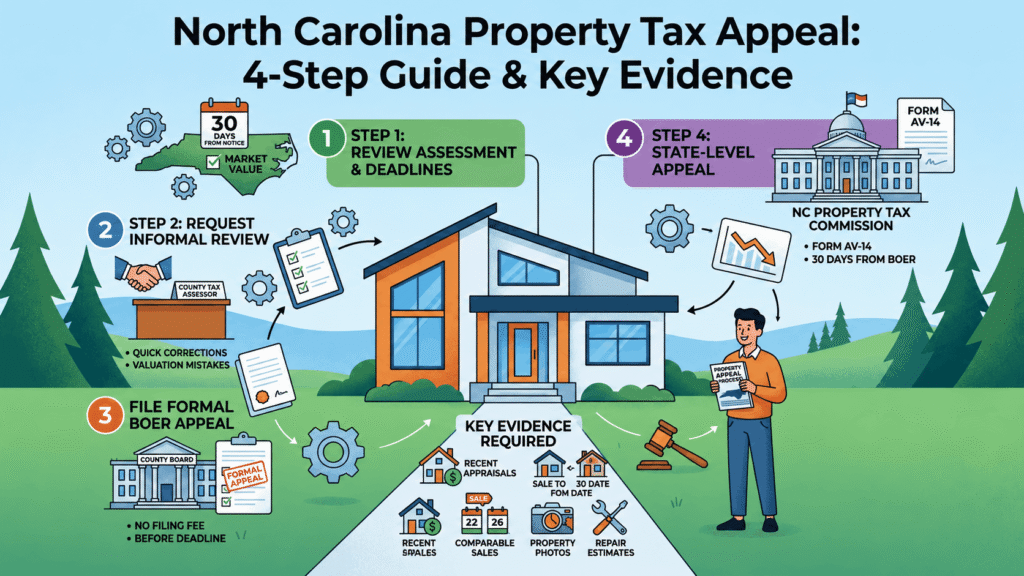
Review Your Property Assessment Notice
Check Your Assessed Property Value Carefully
Review your North Carolina property assessment notice immediately after receiving it. Compare the assessed value with recent local home sales and current market conditions to determine whether your property may be overvalued.
Gather Strong Evidence for Your Appeal
Build a Solid Property Tax Appeal Case
Collect comparable sales, property photos, repair estimates, appraisal reports, and documents showing incorrect property details such as square footage or structural issues.
Request an Informal Review
Contact Your County Tax Assessor First
Most North Carolina counties encourage property owners to resolve disputes informally before filing a formal appeal. This step may quickly correct valuation mistakes without attending a hearing.
File a Formal BOER Appeal
Submit Your Appeal to the Board of Equalization and Review
If the issue remains unresolved, file a formal appeal with your county’s Board of Equalization and Review (BOER) before the county deadline.
Understand North Carolina Appeal Deadlines
Avoid Missing Important Filing Dates
Most counties require appeals within 30 days of the assessment notice or before the BOER adjournment date, usually between April and May.
Prepare for Your Property Tax Hearing
Organize Evidence and Key Talking Points
Prepare a clear presentation explaining why your assessed property value exceeds current market value using factual market evidence.
Attend the BOER Hearing
Present Your Property Appeal Professionally
During the hearing, board members review evidence from both the property owner and county assessor before making a written decision.
Appeal to the Property Tax Commission
Escalate Your Case to the State Level
If dissatisfied with the BOER decision, you may file Form AV-14 with the North Carolina Property Tax Commission within 30 days.
Explore Property Tax Relief Programs
Check Available North Carolina Tax Exemptions
Eligible homeowners may qualify for senior exemptions, disabled veteran exclusions, or circuit breaker tax deferment programs that reduce property taxes.
File a Court Appeal if Necessary
Final Legal Option for Property Owners
Property owners may appeal Property Tax Commission decisions to the North Carolina Court of Appeals if legal or procedural errors occurred during the case.
Important Deadlines You Must Remember
30 days after assessment notice → File your informal property tax appeal
April–May (varies by county) → Board of Equalization and Review filing deadline
Before the BOER adjournment date → Submit your formal county appeal
30 days after BOER decision → File Form AV-14 with the NC Property Tax Commission
30 days after PTC ruling → Appeal to the North Carolina Court of Appeals
Final Note on County Differences
Although North Carolina follows the same statewide property tax appeal framework, each county may handle the process differently in terms of:
- Appeal filing methods (online portals, mail, email, or in-person)
- Board of Equalization and Review hearing schedules
- Revaluation cycles and property assessment timelines
- Local tax rates, exemptions, and county-specific relief programs
- Processing times, evidence requirements, and hearing procedures
Understanding your county’s specific rules and deadlines is important for filing a successful North Carolina property tax appeal.
Common Mistakes in Property Tax Appeal Process
Missing the Property Tax Appeal Deadline
One of the biggest mistakes property owners make is missing the county appeal deadline. Late submissions usually result in automatic rejection, even if your property assessment is clearly inaccurate or overvalued.
Appealing Based on High Taxes Instead of Market Value
Property tax appeals must focus on incorrect market value, not high tax bills or personal financial hardship. Strong market evidence is required to prove your property assessment is too high.
Using Weak Comparable Sales Data
Using foreclosure sales, outdated transactions, or unrelated properties weakens your property tax appeal. Always use recent comparable sales from the same neighborhood with similar property size and condition.
Letting Emotions Control Your Appeal Hearing
Board members review factual market evidence, not emotional arguments about rising taxes. Stay professional, organized, and focused on comparable sales, repair estimates, and documented property condition issues.
Failing to Review Property Record Card Errors
Incorrect square footage, bedroom counts, lot size, or building details may increase your assessed value. Carefully review your county property record card before submitting your property tax appeal.
Submitting Incomplete or Weak Evidence
Strong property tax appeals require appraisal reports, comparable sales, contractor estimates, and property condition photos. Missing or weak evidence lowers your chances of receiving a property assessment reduction.
Stopping the Appeal After a Local Denial
Many property owners quit after losing a local appeal hearing. If necessary, continue your case through the Property Tax Commission to challenge inaccurate property assessments at the state level.
Use Strong Comparable Properties (Comps)
Choose comparable properties that are:
- Located in the same neighborhood or school district
- Similar in square footage, age, and property type
- Recently sold within the last 3–6 months
- Comparable in condition, upgrades, and lot size
- Verified through MLS records or county sales databases
Strong comparable sales data helps support accurate home values, stronger negotiations, and successful property tax appeals.
Document Property Condition Issues
Keep detailed records and clear photos of:
- Structural damage or foundation problems
- Roof leaks, plumbing defects, or HVAC issues
- Mold, water damage, or environmental hazards
- Needed repairs, renovation costs, and contractor estimates
- Incorrect or outdated property condition details on records
Strong physical evidence and inspection documentation help support property tax appeals, real estate negotiations, and accurate property valuations.
File Your Tax Return Even if You’re Unsure
If you received a Notice to File from the Department of Revenue or had state taxes withheld, it is usually better to file your tax return rather than risk penalties or lose a potential refund.
- File your return to claim possible tax refunds
- Avoid late filing penalties and additional fees
- Complete your federal return before filing state taxes
- Use electronic filing for faster and more secure processing
- Contact free tax assistance programs if you need help
Understand Your County Rules Before Taking Action
County rules and local regulations can vary significantly depending on where your property is located. Before filing permits, property appeals, or legal documents, review your county’s official requirements carefully.
- Check local zoning laws and land use restrictions
- Review county property tax rates and reappraisal schedules
- Use GIS maps to verify parcel boundaries and zoning districts
- Search county ordinance libraries for noise, building, and permit rules
- Contact local county offices directly for accurate filing procedures and legal guidance
Frequently Asked Questions
1. How long do I have to file a property tax appeal?
Most counties require property owners to file an appeal within 30 days of receiving the assessment notice or before the Board of Equalization and Review adjourns.
2. What evidence is strongest for a successful property tax appeal?
The best evidence includes recent comparable sales, professional appraisal reports, repair estimates, property condition photos, and proof of incorrect property record details.
3. Do I need to attend the BOER hearing in person?
Many counties allow property owners to submit evidence without appearing in person, but attending the hearing may help explain your case more effectively.
4. Can I appeal again if my county denies the request?
Yes. If your local Board of Equalization and Review denies the appeal, you may escalate the case to the Property Tax Commission using Form AV-14.
5. Do all counties follow the same property tax appeal process?
The overall appeal framework is statewide, but counties may differ in filing methods, hearing schedules, evidence requirements, and processing timelines.